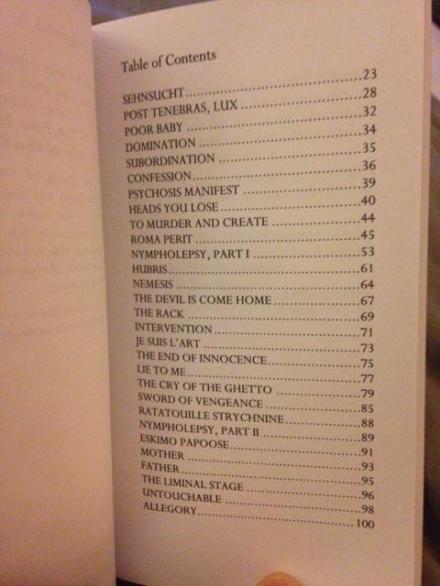
Actual chapbook of Milo Yiannopoulos poetry, written 2007
The hardest part about reading Milo Yiannopoulos lately is figuring out if he actually means what he says. His Breitbart persona is so trolly that it’s easy for Yiannopoulos to characterize anything he writes as a joke, and his critics as fools who can’t distinguish between reality and hyperbole. And because of this, it’s easy for Yiannopoulos to wash his hands of any individual thing he writes, even if it results in his subjects getting harassed or stalked by his readership.
But from what I can tell, Yiannopoulos sincerely means the repulsive stuff he writes. If you go back to Yiannopoulos posts written when he was writing for The Catholic Herald, he says the same things in a more serious-faced tone, befitting of the reputable media networks who used to give him column space. Having burned all his professional bridges back in 2013, Yiannopoulos paints himself ever deeper into his extremist corner, pandering to an increasingly cloistered audience of 18-to-34 year old white nationalists, #Gamergaters, and MRAs. Quality Yiannopoulos quotes are usually beyond parody.
So then, the best way to get to know what Yiannopoulos believes is to read his writings. But this too presents a problem, since Milo Yiannopoulos has racked up dozens if not hundreds of posts, and I want to sample this river of bile in a fair and balanced manner. To cover it all will take several stories, each episode covering a different chapter in Yiannopoulos’s life, dealings, and public statements. This initial release is the first two acts of what I expect to be a five-part retrospective about Yiannopoulos as he presents himself in his own words.
Part 1 – Catholic Guilt

“Railway Toilets III”, by Milo Yiannopoulos
In a recent interview for Sky News about anti-gay hate crime in rural English villages, Yiannopoulos brought up his own childhood as a defense against the existence of gay hate crime in Britian. Yiannopoulos had this to say of his growing up:
“Well, I grew up in a very small village in Kent. And actually you know people who live in the country and who grow up in rural places in England are some of the most tolerant and some of the most welcoming, some of the loveliest people in the country… I’ve lived in a small community and I was noticeably different. I remain noticeably different… I was the only gay in the village, and as I said to you, my experience of rural English life has been delightful. The people of this country are some of the most tolerant, welcoming, open, wonderful people in the world.”
Rambling a mile a minute over the bamboozled host, who clearly wasn’t expecting to debate the existence of homophobia in Britian, Yiannopoulos insists “a vast ecosystem of largely publicly funded organizations” contribute to the appearance of homophobia where there is none. But in reality, Yiannopoulos seems to have experienced homophobia firsthand, both from his community and from within his own family.
Milo Yiannopoulos was born Milo Hanrahan on October 18, 1984. By Milo’s own accounts, his childhood was not a very happy one. In a Breitbart piece titled “I’m Glad my Mum Drank While Pregnant… I Might Not Be Here Otherwise“, Yiannopoulos states that his mother and father were “splitting up” around the time he was conceived, but stayed together because of the pregnancy. According to Milo, they separated when he was six.
Yiannopoulos’s mother appears to have rejected him when he came out, causing him to change his surname to “Yiannopoulos” around that time. Although Milo occasionally claims some Jewish ancestry, he was in fact “brought up Catholic” by his paternal grandmother. Indeed, Yiannopoulos still describes himself in an AMA as “Basically mostly Catholic, though a terrible one.”
This grandmother appears to have been more supportive of Milo than either of his parents, allowing him to live with her in his teens and willing him money from her estate. In a 2012 obituary he wrote for his Nana Petra, Yiannopoulos relates what this was like:
Nana had spooky levels of intuition about people, which made her a fearsome adversary. Her annual feuds with my mother were spectacular – as, on occasion, was her language when my mother’s name came up. Needless to say, it was she who emerged victorious from the skirmishes, dusting off her velvet cuffs and muttering “uppity cow” under her breath. (This was to become a favourite expression of mine.) As a child, I remember Nana sweeping magisterially through the house in layers of silk and brocade, archly passing judgment on the issues of the day.
But she was a deeply tender woman, too, who loved unquestioningly and unconditionally, and enjoyed expressing her affection through matriarchy. I can’t imagine what trouble I must have put her through in my late teens, when I lived with her after finding it impossible to co-exist with either of my then-separated parents. She was there, looking on with mild astonishment but never disapproval, when I dressed up as Cleopatra and rolled myself up in her carpet, drunkenly sobbing and yelling “Where’s my Rex Harrison?” (I was 19.) …
Above all else, Nana enjoyed keeping an eye on things. Not just because she enjoyed a good snoop – though she certainly did – but because she was a woman for whom duty and care were the pre-eminent virtues. Without her, I would not have developed much of a sense of right and wrong. “You can be a catty little queen at times,” she’d say. “But your heart’s in the right place.” If she was right, it was thanks to her own instinctive sense of morality and her uncanny ability to suss people out.
She was by far the first person to twig that I was gay. My mother was awful about it, my father was surprisingly understanding, but Nana showed just the right amount of acceptance and concern. “It’s not a happy life,” she would say. “But if you stay safe and away from drugs, you’ll be alright.” Dad and I always laughed at that. “Just look at your bloody cupboards,” he’d say. “You’re the biggest junkie I know!” She’d allow herself a smirk at this, now and again, in between puffs of the Nebuliser.
Despite the support, Yiannopoulos has a pretty dim view of gay people and gay rights, including his own. In a piece written by Yiannopoulos in 2011 titled “Why I’ll Probably Never Be a Parent”, he relates his “horribly lonely, miserable experience” of being a gay man, while forswearing the possibility of ever having children (which he very much seems to want):
But the thought that I might influence my child towards a lifestyle choice guaranteed to bring them pain and unhappiness – however remote that chance may be – is horrifying to me. That’s why, quite simply, I wouldn’t bring a child up in a gay household and, if by some chance I were to end up having a child with a woman, I would seek to insulate that child from inappropriate situations and influences until they were old enough to understand the principles, ramifications and, yes, the mechanics surrounding such an enormous decision. …
I’d describe myself as 90-95% gay. I would never have chosen to be this way. No one would choose it. You’d have to be mad. …
But everything isn’t OK. And, ceteris paribus, no one would choose to have a gay child rather than a straight one. It would be like wishing that they were born disabled – not just because homosexuality is aberrant, but because that child will suffer unnecessarily. Again, you’d have to be mad. Or evil. …
Is being homosexual “wrong”? Something somewhere inside of me says Yes. You probably don’t agree. But I think we can all agree that, unless you live in the cosseted bubble of a liberal metropolis, the reality of growing up gay for most people is a horribly lonely, miserable experience. (If you don’t know, take it from me: it is.)
The feelings of alienation and rejection it engenders are responsible for the sorts of repugnant tribal posturing you see on the streets of Soho on a Friday night, as bitterly unhappy queers engage in degrading and repulsive behaviour, simply because they want to feel a part of something after a lifetime of marginalisation. …
Ironically, it’s precisely that profound feeling of being somehow broken that means a gay man’s sexuality often comes to be the defining characteristic of his personality. Who wouldn’t want to protect a child from a path that leads to such destructive self-loathing? …
But the battle for gay rights has been won. All these preening poofs in public life do is make life more difficult for regular young gay people by reinforcing the stereotypes about gay behaviour: reminding a struggling child’s myopic dad that queers are uppity, in-your-face, camp-as-tits faggots who’ll rape you as soon as look at you. …
Recently, a good friend of mine became pregnant. She’s a sassy chick with what the glossies call “a fabulous international lifestyle” and lots of metropolitan friends. But if the gags about fairy godmothers become more than a joke, I’ll probably, no doubt inappropriately, transgress the tested limits of our friendship and tell her so. Because her child deserves to be protected from the seedier aspects of life until properly equipped to cope with them.
And that’s why I’ll probably never have a child of my own – which isn’t a statement I make with any pleasure.
I think I’d have made a great dad. I mean, aside from being clever and charming and witty and fantastically good looking, I’d spoil them rotten while being fastidiously attentive to their academic performance and career aspirations. But it’s wrong to expose an innocent child to the possibility of gay influence.
I don’t hate myself and I don’t hate my sexuality. (Granted, I have a complicated relationship with the latter.) Nor do I hate other gay men. (Where would fat girls be without them?) But if my beliefs about raising kids get me branded a homophobic homo… well, so be it.
It’s hard to dismiss a post like this one as hyperbole: Yiannopoulos genuinely seems to believe being gay leads to “destructive self-loathing”, describes other gay people as “preening poofs” and “camp-as-tits faggots who’ll rape you as soon as look at you”, and believes that his friend’s baby-to-be “deserves to be protected” from gay men such as himself, because it’d be “wrong to expose an innocent child to the possibility of gay influence.” This suggests Milo is serious when he says “Kids need a Mum and a Dad” on Breitbart, or that “Gay Rights Have Made Us Dumber, It’s Time To Get Back in the Closet” or, “Gays! If you want to start giving blood, stop being sluts.” And when Milo’s sex partners post photographic proof of Yiannopoulos’s one-night stands, he looks kind of annoyed and depressed with the proceedings.
In fact, it appears Milo has tried to get back in the closet at least once. In a bizarre 2011 blog post titled “Engaged”, Yiannopoulos announced:
Yesterday I proposed to a woman I do not yet know intimately, but with whom I wish to share the next chapter of my life. She accepted.
It will be an unconventional marriage, to say the least, but I am confident we will make each other very happy. I hope you will join me in celebrating soon.
I don’t know which is sadder: for this announcement to be genuine, or just made up for appearance’s sake. At any rate, Yiannopoulos never mentions the engagement, or this unnamed woman, ever again.
Part 2 – Ambition and Failure
Milo Yiannopoulos has fallen pretty far since Forbes called him “Digital Media’s Citizen Kane.” Posts from this stratum read like the first 1/3rd of Jurassic Park, with Yiannopoulos insisting The Kernel is a safe and worthy investment, as it became increasingly evident that everything was falling apart at the seams. By the end of his run as a media mogul, Yiannopoulos was blackmailing his employees in response to their lawsuit regarding Yiannopoulos’s nonpayment of wages. This 2012 interview, which I’m going to reprint in its entirety, marks Yiannopoulos’s zenith; his 15 minutes of fame as a controversial techno-conservative. But even at this moment of triumph, you can see the cracks in his story:
Out of the London tech scene comes a 28-year-old journalist/entrepreneur surrounded by controversy whereever he goes. Whether it was the publishing of his private dispute between himself and the tech editor of The Guardian or numerous public arguments on Twitter with start ups founders, editors and the self-proclaimed technorati — this is one man who isn’t afraid to say what he thinks.
Milo Yiannopoulos however is doing one thing that most media have become afraid to do. Speak up and out about hypocrisy and well, the white-washed news that colors the UK and European tech start up scene. In 2011 and 2012, Yiannopoulos was named one of the 100 most influential people in the UK’s digital economy by Wired UK. He hosted the Young Rewired State competition in 2010 to showcase the tech talents of 15–18 year olds. He’s also an outspoken gay Catholic who writes for the Catholic Herald.
In 2011 his raison d’etre, the Kernel, was born. Today, December 19, The Kernel celebrates its first year in existence and proves it’s possible to bring back old school journalism, with some serious edge in the digital age.
The Kernel is a mash-up of Gawker meets Vanity Fair topped with technology, politics and media news and commentary the way you wish media would write about such things. Today, the Kernel has about 140,000 unique readers a month; 40% from the UK, 40% from the US and 20% from the rest of the world.
In honor of The Kernel’s first anniversary, Forbes caught up with bold Yiannopoulos to find out what makes him tick. (Answers in British English)
Forbes: Let’s start with something dark, what’s your addiction?
Milo Yiannopoulos: Seeing the wicked suffer. That sounds a bit psychologically disturbed, I know, but it’s the reason I went into journalism and I think it’s the reason most people do. I’m probably a bit more forthright about my opinions and prejudices than most journalists, but then I’m a columnist by nature, not a reporter. At the Kernel we very much see ourselves as crusaders for truth and justice, as daft as that sounds. Some people might find that sinister, but a strong editorial line has been a crucial part of our proposition from day one.
“A bit psychologically disturbed”? It sounds a lot psychologically disturbed – and it’s more disturbing when you consider how many times Yiannopoulos has launched full-on smear campaigns against individuals throughout his journalistic career. “Seeing the wicked suffer” is how Yiannopoulos justifies trying to smear his ideological enemies; “truth” and “justice” according to him are functionally indistinguishable from “malice” and “revenge”.
Forbes: Truth and justice – admirable, but where does journalism fall between those pillars?
MY: The only publications that will make money are focused, high-quality publications with a ruthless attention to detail, publishing comment and analysis you can’t get anywhere else. Everyday news will just have to be subsidised by other things, because it will never make money.
Forbes: That’s a tall order, so why did you decide to take on the daunting task of digital publishing?
MY: I was, shall we say, invited to take a break from the national newspaper at which I cut my teeth – about four times. Mostly, it wasn’t my fault. But after the last incident I realised I was probably unemployable and that I should go freelance. I started looking around for a magazine or newspaper to approach for a column and realised there was really no one out there I wanted to write for. So, for the past year, I’ve been trying to create the magazine I always wanted to read: a blend of gossip, news, authoritative comment and analysis, with a healthy dose of mischief.
Forbes: You’re the harbinger of controversy. How do you reconcile your personal opinions with your knowledge of the facts versus the gossip you hear in the industry?
MY: I’m in a slightly odd position in that, as a journalist, I don’t have that many friends in the media.My friends are the entrepreneurs. It’s ironic, really, because it’s the entrepreneurs I give a hard time. As a result, I know the people and businesses in the technology industry intimately, and a lot better than my colleagues, but it can be difficult knowing so much more than you can ever publish. If I ever felt like burning all my bridges, I could have three months of riotous daily exclusives. It would probably bring down the industry.
Forbes: Well on that note, and this gives us a chance to see what you’re made of, what’s your biggest failure?
MY:I dropped out of university twice. I try to tell myself I’m in good company, but ultimately it doesn’t say great things about you unless you go on to terrific success in your own right – which, in my case, remains to to be seen. I may go back to Cambridge at some point. I know I should.But it’s hard when you’re approaching 30 and building a company and traveling all over the world and doing TV and all the other stuff people say you get your degree to be in with a chance of achieving to pull the plug and go back to writing essays about representations of addiction in Marlovian anti-heroes.
Talk about privileged. Some people don’t even get to attend university once, let alone drop out of it twice.
Forbes: What aspects of the character Charles Foster Kane, do you identify with the most?
MY: Inasmuch as I’m a publisher who ought never, ever to run for public office, yeah, maybe there are some similarities! Beyond that, I don’t know. As a side note, The Kernel’s version of “rosebud” is probably “mooncup”. Only long-time subscribers will know what that means.
Forbes: Is it safe to assume that Nick Denton influenced you?
MY:Absolutely. Gawker’s politics and business model are very different to ours, but I admire Nick enormously. He’s managed to build a profitable new media property from scratch, which is just extraordinary. And, more than that, Gawker is a powerful editorial force and a cultural icon.That’s what I’m most in awe of. I try not to pay too much attention to his legendarily bad-ass management style, though, because I’m not the best manager of people myself and I have a tendency to expect way too much from people. It’s hard but you have to accept that not everyone is going to be as invested in the project as you are.
Forbes: Since we’re on the topic of Gawker, let’s talk money. Denton had a lot of cash to start Gawker, you didn’t. What did it take to get investors to open their wallets for the Kernel? The funding of digital media outlets isn’t top of the heap.
MY: We’re engaged in the long process of another round of financing at the moment, after bootstrapping the company to this point. Of the five co-founders, three put in money a year ago when we launched. I’ve sunk about £50,000 into the Kernel so far, I think, most of which has gone on lawyers. But that’s just the cost of doing business, particularly doing a media business that publishes punchy editorial. I don’t know whether I should be proud of the fact that we spend double on lawyers what we do on editorial, but there you go. It’s an expensive business and I’m just trying to keep the company above water while we grow. Not drawing a salary for a year is no fun, though, let me tell you.
Remember, this is the interview listed #3 in the citations for Milo Yiannopoulos’s Wikipedia page; it’s his big claim to fame. But even here he admits he’s “boot-strapping the company”, and twice mentions the need for “another round of financing”, or “a bit more financial security.” He even says “Not drawing a salary for a year is no fun, though, let me tell you”, foreshadowing the very problem that ended up sinking the Kernel. In hindsight, is it any surprise this guy failed to pay his contributors?
But the real reason it’s difficult to get investment into media companies is that they just don’t make money. They never have. There are newspapers that have been run at a loss for almost their entire lives. The truth is, owning a media company is a luxury and it’s something that people do because they believe in a set of values and want to propagate their morals and their opinions. Only fools go into media to get rich, because a vanishingly small number of editorial products are profitable in their own right.
Forbes: Ok got it, no fools, only truth and justice. One year later, what’s missing now with the Kernel?
MY: We’ve just expanded into Germany, which is really exciting. What I need to do over the next six months is close enough money and grow revenues enough for us to open a New York office. I don’t see anyone in New York doing what Gawker used to do so brilliantly with Valleywag on the west coast, and I think our brand of journalism would go down very well there. But we need a bit more financial security before we make that leap, not least because I’ll then need to shuttle between London, Berlin and New York every month. Yuck.
Forbes: What do you want people to say about you? About the Kernel?
MY: I didn’t hate it when the Observer called me a pit bull, which I guess compared to other tech journalists I am. As for The Kernel, people sometimes say it’s the publication they hate, but they’re glad exists. I can live with that. I’ll admit I do get a kick out of rubbing humourless people’s noses in it sometimes. When we do silly, fun features like the “best butts in London tech”, other journalists go ape shit but the readers love it. That gets me off.
Forbes: Why do you think you get people’s ire up so quickly?
MY: It’s simple really. People get upset because we do something relatively unique in technology journalism: we tell the truth.
Forbes: Since you are crusader for journalistic integrity, what gets YOUR ire up?
MY: I despise what the technology industry has done to language and the creep of words like “disruptive” into everyday speech. And it makes me mad that every idiot with a laptop is now a “CEO”. The Kernel’s style guide has an impressively long list of banned words. But that’s just nitpicking really. What matters is what people do. Great writing has no rules. It’s about telling a story with sharp language, a rampant imagination and a wicked sense humour.
Forbes: Even Hearst had an end game, what’s yours?
MY: I want The Kernel to be the Spectator of tech: a publication that commands respect and authority within its own industry, even if it’s occasionally purposefully reactionary, controversial or even childish,and a publication that translates the world it writes about for the educated layman, telling him what he needs to know and what to think about it. All things considered, we’ve made great strides in that direction already.
I’m unclear on why Forbes thought Yiannopoulos’s product was so valuable. Clearly, the market itself didn’t place a very high premium on “purposefully reactionary, controversial or even childish” news stories that told readers “what to think”. I know this because Yiannopoulos’s paid newsletter, the Nutshell, didn’t get enough subscriptions to cover the Kernel’s costs. What’s more, those who did subscribe to The Nutshell quickly unsubscribed, complaining that the paid newsletter arrived too infrequently to be worth the money.
To cope with the lack of funding, Yiannopoulos stopped paying his contributors, who were forced to make legal injuctions against him just to collect their salaries. He’s even on the record for threatening one of his contributors (former associate editor Margot Huysman) per email. She widely circulated these messages from Yiannopoulos during the 2012-2013 scandal:
On Friday, 14 December 2012, Milo Yiannopoulos <yiannopoulos@kernelmag.com> wrote:
You’ve already made yourself permanently unemployable in London with your hysterical, brainless tweeting, by behaving like a common prostitute and after starting a war with me, as perhaps you are now discovering.
On 17 Dec 2012, at 12:39, Milo Yiannopoulos <yiannopoulos@kernelmag.com> wrote:
You’ve not only torpedoed your chances of ever having a career in journalism in London, but you’re rapidly losing my sympathy as well.
The more I hear of your feverish gossiping, the more I’m moved to publish the real story. The shameless, disgusting, drunken sluttishness, about which the entirety of [redacted] was sniggering on a daily basis. Your reputation on the start-up scene, propagated by your ‘friends’. That *delightful* photograph from the [redacted] party.
Obviously, this attempt to silence Huysman backfired- she circulated these emails to pretty much anyone with an interest in the growing scandal, and Yiannopoulos found himself the subject of some pretty unflattering news stories from other technology journalists. Even in 2014, Milo held a pretty vicious grudge against Huysman:
I’m amazed Margot could form words to complain, she had so many dicks in her mouth at the time. Not that I’m judging: her lust for cock is second only to my own. But when someone alludes to me as a slattern I don’t go squealing to the papers. I accept it for the fact it is.
By March 2013 the Kernel went offline, and a high court ordered Yiannopoulos to pay back nearly 17,000 pounds he owed in back wages. Former Kernel Editor Jason Hesse had this to say of his boss Yiannopoulos:
“Milo never paid me a penny for the work I did as editor, nor for the three months of hosting bills I paid for The Kernel, nor for the money I lent to him personally. Why he thinks he can just get away with it is beyond me. I hope that the high court’s order will help him finally understand that it isn’t his choice to decide whether or not he wants to pay me; it’s the law.” …
“His refusal to pay those people that he’d hired is simply unacceptable, though in hindsight, I don’t believe he ever had the money to pay me or Margot. It certainly would be interesting to see the company’s accounts.”
The Kernel also seems to have failed at ethical journalism. Investor & actual entrepreneur Steve Karmeinsky had this to say of Yiannopoulos’s startup:
“The Kernel had the opportunity to write about real issues in the London tech scene, which is one of the most vibrant and exciting technology development spaces globally, unfortunately, rather than that, it morphed into a celebrity/gossip magazine; rather than being the Economist of the sector, it was very much the ‘National Enquirer’. Further, it became just a mouthpiece for Milo Yiannopoulos to write nice things about his friends.”
The Kernel’s spectacular failure and Milo’s resultant Twitter slap-fights lost him still more friends & contributors. According to yet another Guardian article regarding the scandal:
David Rosenberg, a university friend of Yiannopoulos’s – who co-founded the Kernel, but left day-to-day operations in January to work for location company FourSquare, remaining on the editorial board – told the Guardian: “I don’t like the way [Yiannopoulos] picks [virtual] fights with people … I tried to extricate myself from his fight-picking.”
He had not received a salary from the site, Rosenberg said. …
It was next rumoured that [Yiannopoulos] would start a venture capital company, Hipster Ventures, that would take European startups and launch them on the US west coast. But Hipster Ventures, formed with university friend David Rosenberg, filed for dissolution on 26 July 2012, the day after Rosenberg resigned from the company leaving Yiannopoulos as the sole director.
Rosenberg told the Guardian he had been annoyed to discover that Yiannopoulos had included him as a director of Hipster Ventures “without really discussing it” and resigned his position as soon as he discovered it. He said he had made it plain to Yiannopoulos that it “won’t happen again”.
Ultimately, Yiannopoulos made arrangements with a German venture capital company (despite having derided venture capital as “a middle class dole queue” in the past) in order to pay off his debts and re-launch the Kernel. Reading this article about the buyout, it’s apparent how far Yiannopoulos has fallen in the eyes of his colleagues:
An infamous online magazine forced to close over unpaid wages is set to be re-launched with its divisive founder in charge after paying off debts of over £24,000. …
The site mixed bitchy gossip about the London tech scene, such as an article asking why one German entrepreneur is so sexy, with more considered think pieces. The site led The Observer to dub Yiannopoulos the “pitbull of tech media” while Forbes called him “digital media’s Citizen Kane”.
But the publication was dogged by complaints from employees and contributors of unpaid wages.
Yiannopoulos’s acerbic and often offensive tone – with articles such as “Put a sock in it you dickless wonders” about the number of women at tech conferences – also attracted numerous critics, including The Guardian‘s technology editor Charles Arthur whom Yiannopoulos claims led a “campaign” against the site.
The Independent on Sunday can reveal that The Kernel will be relaunched in August, backed by German venture capitalist firm Berlin42 and with Mr Yiannopoulos remaining as editor-in-chief.
Berlin42 has acquired the domain for an undisclosed amount, and founding partner Aydogan Ali Schosswald will join its newly formed publishing company, Kernel Media, as chief executive. Yiannopoulos, who has been based in Berlin since April, privately settled debts owed to six former employees and freelancers amounting to around £24,000 in April. He stresses he would not repeat the financial mistakes he made, saying Berlin42 was providing a “runway” to fund the relaunch.
This relaunch proved short-lived. Within six months, The Kernel was sold again, this time to The Daily Dot, and Yiannopoulos was demoted to the position of columnist at the publication he used to own. He only held this post for a few months. Reading articles of his from this time, such as “Why I think wearable tech is for creeps”, it’s not hard to to see why the Kernel let him go. At this point, Yiannopoulos seems to hold his own beat in contempt:
Well, first of all, the watches, headsets and assorted wearable paraphernalia released to the public so far are desperately unappealing. Ugly as all hell, in fact, as I put it last night when asked to speak to Sky News about this predictable industry failure.
Second, they are probably the creepiest set of products ever to come out of Silicon Valley—which is saying something.
That’s why celebrities have been reluctant to endorse them or be seen with them in public: They are too odd to appeal to normal people. I’ve got nothing against geeks, with their radical transparency agendas and horrible dress sense, but here in the real world being a geek is not and never will be cool. Sorry, but it’s true. …
So hideously weird are Google’s glasses that there’s even a name for people with the lack of manners and taste it takes to sport them: “glassholes.” And geeks who venture onto the street wearing Glass are being routinely assaulted by members of the public.
What’s mystifying are not the assaults but the brains of people who think it’s OK to wear surveillance cameras on their faces as they go about their daily lives. I hate to be rude, but is there something a bit…wrong with these people?
Leaving your office with a camera strapped to your face that could, at any moment, be secretly photographing women on the subway, or taking covert footage of private citizens, is a grotesque social provocation.
No civilised person would condone theft or physical assault, but I reckon most regular punters would agree that these glasshole provocateurs are getting exactly what they deserve.
Writing apologia for assault if the victim is wearing Google Glass a pretty extreme position for a tech journalist to take about the beat he covers. It almost seems Yiannopoulos grew to hate tech journalism after his failures at The Kernel. It also seems that #Gamergate found Yiannopoulos at just the right moment: Yiannopoulos hasn’t written anything for the Kernel or Business Insider since getting involved with #Gamergate.
Having destroyed his professional relationships, it would appear Yiannopoulos’s match with #Gamergate is one made out of necessity. He lacks the funding to create another start-up, and he lacks the professional cache to write for anywhere more substantial than Breitbart.com. Other failed journalists seem to hold him in contempt. Truthfully, he’s not an ideal candidate to be writing about ethics in games journalism – given Yiannopoulos’s personal history of stiffing his employees and blackmailing them to cover it up, it’s questionable whether Yiannopoulos actually knows what ethics are.
Thankfully, #Gamergate is not about ethics in games journalism, or at least not in any meaningful way. Functionally, it’s an online hate group dedicated to stalking a handful of women in tech, whose connections to white supremacists, illegal hackers, and other hateful losers has been pretty well documented. Since Yiannopoulos despises women in tech almost as much as his #Gamergate fans do, he sticks with them, willing to overlook their contradictory demands if they’ll overlook his personal hypocrisies.
In my next installment, I’m going to go discuss where Yiannopoulos went next with his career – namely, to internet stardom in a little hate group named #Gamergate. I do hope you’ll join me for that, and thanks for reading.


 Internet Famous Angry Men





You must be logged in to post a comment.